Seen 07 MAY 2021
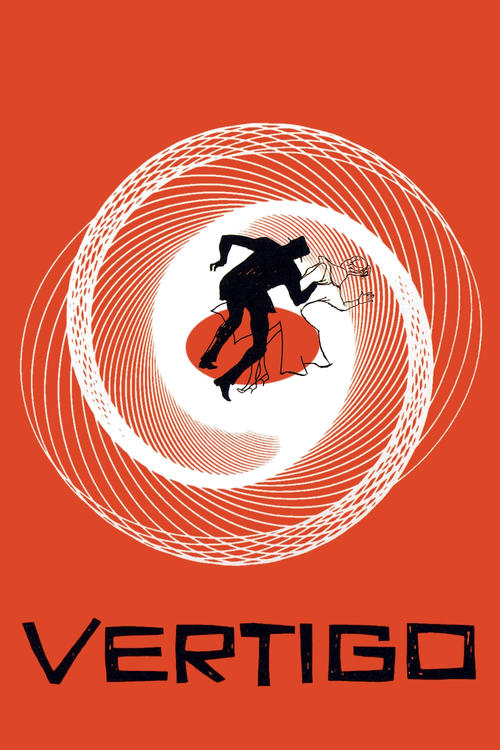
Vertigo 1958
- Director
- Alfred Hitchcock
- Year
- 1958
- Runtime
- 128 min
- Rewatch
- No
- Letterboxd
- @zanadu →
Analysis of the kiss scene for my film class:
Hitchcock may be known as the master of suspense, however, this description fails to properly commend the famed director for all that he is able to achieve in every scene. This description misses the trees for the forest; his pictures may staple the audience to the edge of their seats, but it is the scenes, and often not even the suspenseful scenes, which demonstrate the talent and vision of Hitchcock the auteur. The kiss scene in Vertigo (1958) between Scott, played by James Stewart, and Judy, played by Kim Novak, is one such example. Hitchcock blends cinematography, mis en scene, color, lighting, blocking, acting, and score to construct a pivotal moment in Vertigo: the moment in which Scott is wholly consumed by, and believes to have conquered, his unwavering attempt to recreate a life with Madeleine.
The scene revolves around the current state of mind of the protagonist Scott and the reality he wishes to manifest. At this point in the movie, Judy has been all made up to look like Madeleine and is currently fixing herself up in the bathroom, eager to earn Scott’s approval yet again. Scott begins the scene with a forlorn look; he is unsure if his ploy is going to work and if he can properly recreate a semblance of his true love. The first, and perhaps most noticeable elements in the scene which help illustrate this point are the set design, color, and blocking.
Before Scott is granted a glimpse at Judy’s recreation of Madeleine, his current perception of reality can be best described as unstable. He is unsure of what he’s becoming by trying to recreate his lost love and also does not know if his attempts will be successful. This misperception of reality is represented by the set design. The door to Judy’s bathroom is closed which implies secrets and a lack of knowledge. So, with this insight into “reality” closed off from him, Scott turns to the windows, the most direct line of sight to the outside world and reality as it is. However, Hitchcock has blocked the windows off with drapes; Scott is unable to adequately perceive the outside world, or reality as it is. There is, however, one element of the outside world which Hitchcock utilized to grant insight into the mental state of our character: the green light of a neon sign.
Typically, the color green represents life and vitality. Although the outside world and reality are obscured from Scott and the viewer, the motivation in his mind is clear as day. Scott is consumed by the attempt to bring Madeleine back to life. He looks around the outside world in an attempt to perceive reality, but by leaving only the light of the neon sign in frame, Hitchcock makes Scott’s current state of mind apparent. His reality is shrouded by his unwavering attempt to “bring back the dead” and see Madeleine once again. He is consumed by the thought of life; his windows to the outside world, and reality accordingly, reflect this sole motivation.
The blocking, and actor’s expressions, as the scene progresses continue to reveal the character’s inner thoughts. After Scott looks out the window and realizes this goal is all he truly cares about, he looks back to the bathroom door to see if his true love has emerged. She hasn’t, and immediately a look of depression falls across Scott’s face. He turns back to the window, as if questioning the feasibility of altering his reality, and takes a seat, dejected by his failed attempt. He hears the door click open and slowly looks back, the hope creeping back into his face. Timidly, he looks to the bathroom door and begins to rise. Hitchcock decides to impress upon the audience the weight of Judy’s transformation in Scott’s eyes through the use of camerawork. As Scott sees Judy emerge, and realizes that he may once again be with his true love, Hitchcock pushes the camera in. The “push-in” perfectly expresses to the audience the impact that this moment has on our main character. Scott's look of longing and hope help drive in this point as the camera draws the audience nearer to him.
The composition of the shot in which “Madeleine” emerges further conveys Scottie’s torn state of mind. Judy emerges from the bathroom with the green light of the neon sign. Initially, he perceives her as being reborn. However, Hitchcock presents her in a sort of fog as she steps out from the bathroom, which lends an eerie, supernatural quality to her. Although the green light is present, it is muddled and distorted by the fog. Even though Scott wants to believe that Madeleine is now with him again, he acknowledges that the only way this could truly happen is if there were something supernatural at play. Madeleine is present but the unnatural quality of the situation is not lost on Scott. In addition to the green light, Hitchcock meticulously organizes the mis en scene; he covers the bed with flower imprinted sheets and hangs a painting of flowers on the wall to both recall Madeleine’s falsified obsession with flowers but more importantly, to surround her with imagery of life. When Scott looks at Judy emerge, he sees imagery preternaturally confirming to him that his twisted fantasy has come to fruition: Madeleine stands before him, shrouded in the green light of life, and surrounded by symbols of life.
The blocking and shot type used in the following sequence is of paramount importance to this scene as a whole. This is the sequence in which Scot and Judy see each other in this potentially new phase of their relationship. This is the moment that each of them decides if they will accept the other and revert to the “true love” relationship they believed they had before the incident. To illustrate this, Hitchcock must maintain both characters as key players in the sequence and must also demonstrate cinematically how important this exchange of glances truly is.
Judy takes the first step in forming the bond. She steps forward timidly, carefully looking into her love’s eyes, analyzing his expression to see if he’s instantly fallen back in love with her. Hitchcock allows us a glance at what Judy perceives. Since she feels distant from Scott at this point, he only grants us a brief, medium shot of Scott; we can’t get too comfortable with him, and we empathize with Judy who feels distant from him as well. Hitchcock cuts back to Judy as she steps closer and closer, and almost immediately cuts back to Scott, now with a close-up shot to visually demonstrate that they are in a non-verbal conversation of sorts. They have acknowledged each other and have begun the “dance” of becoming reacquainted. Hitchcock cuts back to Judy, who continues her slow pace forwards, her expression softening as she senses she may have won him over. The camera stays on her for a slightly longer amount of time, serving the dual purpose of allowing the audience to form a more personal, sympathetic connection with her as well as allowing her to step into a close-up shot, being that this is a very emotional and climactic moment for her. In other words, this is Judy's push-in camera moment, except she's pushing into the camera rather than the camera pushing into her. Hitchcock cuts back to a close-up shot of Scott as his expression softens and he steps in to greet his love. To conclude this “dance” of long-lost lovers, Hitchcock cuts to a wide shot with both characters in frame, finally reunited and together as one.
Now for the pivotal moment for which the scene is named after, the kiss. The camera movement, set design, color, and acting are the diegetic elements that manifest in this scene most prominently and purposefully. Scott steps in to kiss Judy and the camera begins its full rotation around the characters; a movement that symbolically demonstrates that Scott’s world is being reoriented and reconfigured. As the camera passes by the bathroom, there is a faint glimmer of the green light that Scott saw as Judy emerged. Now that he is locked in his embrace with her, he can feel a partial semblance of the love he once had with her but he is unsure of the validity of it. Hitchcock further emphasizes this lack of clarity as the camera continues its rotation.
At 180 degrees of rotation, a measure symbolic for demonstrating an exact opposite, the set design changes, and the audience peers into Scott’s mind. Scott thinks back to his former life: the life where he had Madeleine and then lost her. We see him pull away from the kiss and scrutinize his regrets for losing Madeleine and the sanity in his decision to try and “revive” her. His expression darkens for a moment before he realizes that he has someone who loves him in his arms. He leans back into the kiss and the camera resumes its 360-degree rotation around the characters, establishing that Scott’s life has gone full-circle and his acceptance of the choice to recalibrate his life around what he once had.
The camera concludes its rotation with the windows and Scott’s sense of reality in the background and it is here that Hitchcock demonstrates the instability and ultimate confusion in the mind of his protagonist. The windows, and the overwhelming green light, make up the entire background. In this wide shot with both characters in frame, the green light symbolizes that not only is Scott fantasizing about Madeleine being brought back to life, he now fully believes it. He believes he is holding the resurrected Madeleine. However, Judy’s posture tells a different story; her head is positioned quite unnaturally, almost like a corpse, serving a dual purpose. This is a call back to Scott’s belief that Madeleine had an untimely demise as well as foreshadowing for Judy’s ultimate suicide at the end of the movie. In great ironic fashion, Scott is kissing what he now believes to be the resurrected love of his life while her posture suggests that she is not as “alive” as he may think.
A proper analysis of this scene would not be complete without mention of Bernard Herrmann’s exquisite score. The score aids Hitchcock in revealing the inner thoughts of his main characters. Hermannn begins the scene with a light, trembling motif on the violins; likewise, Scott begins the scene with an unstable and anticipatory mental state. Herman’s score, with its quivering violins and slowly elevating pitch, reflects this emotion.
As Scott sees Madeleine, Herrmann adds more instruments to the composition to provide a richer, fuller, different melody, to demonstrate that Scott is now full of mixed and wondrous feelings. The theme digresses a bit as the kiss begins. Rather than a calming, beautiful melody, the rhythm of the music is now more fast-paced and there is more emphasis put on the notes of the beat. This represents Scott’s confused and flustered state of mind. As demonstrated by the set design, Scott’s mind is in a state of disarray, and the faster music and changed melody reflect this. After Scott decides that he is comfortable in the hands of his new, revived love, Herrmann reverts to a rich, slow composition. Furthermore, the music is composed as if it is rising to reach a climax; the music goes in and out from a full sound to a more diminished sound, and back to a full sound rising on the scale. Herrmann conjoins this masterful composition with Scott's state of mind; the score for the scene ends with a crescendo of all the instruments and an emphatic, triumphant sound. Scott has achieved what he set out to do and has recreated his long-lost love.
Incredibly, Hitchcock can convey this grand, emotional sequence without a single line of dialogue. The magic of cinema as an art form is that it can combine all other art forms into one coherent, impactful message. He understood that facial expressions, set design, lighting, color, blocking, and camera movement could do the trick just as well, if not better. He only hoped that his audience would trust in his mastery and be interested enough to interpret it all for themselves. The master of suspense is too belittling of a description for the directorial genius that was Alfred Hitchcock. Perhaps a new description is more fitting: Alfred Hitchcock, the master of cinema